The Five Elements: How Energy Interacts Inside a Home
Every home is born with an energetic blueprint.
That blueprint is created when the home is built or substantially renovated and is mapped through Flying Stars feng shui.
But once we know where the stars are, the next question becomes: What are we actually looking at?
The answer lies in the Five Elements.
The Language of Feng Shui
Each of the nine Flying Stars carries an elemental quality. These elements are not the periodic table. They're the vocabulary through which a home speaks.
The five elemental expressions are:
Water
Wood
Fire
Earth
Metal
These are not viewed as physical objects. They are energetic expressions that describe how energy behaves and moves within a space.
The real work of feng shui is understanding how these elemental energies interact. Some naturally support one another. Others create friction. When I analyze a home, I'm looking at those relationships.
Where is energy flowing smoothly? Where is it getting stuck? Where is one element overpowering another?
The answers reveal a great deal about how a home may feel and function.
Understanding the Relationships
Understanding these relationships is where analysis becomes insight. To illustrate what I mean, let me show you my own home's Flying Stars chart and then walk you through two sectors that tell very different stories.
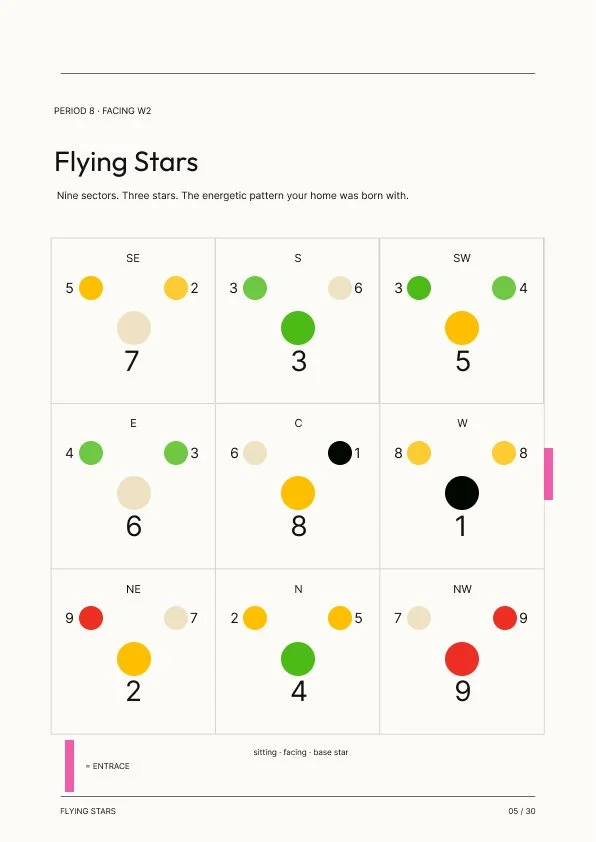
Here's my home's chart. Each sector shows three stars, and each star carries an elemental signature. By reading how these elements interact within a sector, we begin to understand the energetic blueprint my home was born with.
The Center: A Productive Cycle
My home's center sector contains Stars 6, 1, and 8. Metal, Water, and Earth respectively. In the Five Element cycle, Earth produces Metal and Metal produces Water. Rather than competing, these elements naturally support each other in what's known as a productive cycle.
But here's the challenge: my home's center is 80 percent storage space. So instead of an open area, I have a closet situation. The positive star configuration is there, but the energy has nowhere to move.
This is where intentional design becomes essential.
My strategy has been to strengthen the Water 1 star and the Earth 8 star, creating a more robust cycle that feeds outward into the rest of my home because the center always radiates energy outward. And, the 1 and 8 stars are favorable right now. I installed mirrors in the pantry closet to reflect and activate the space (mirrors carry Water energy). In my kitchen pantry I placed bowls, filled with sand, on the top shelves with mirrors positioned behind them. The bowls themselves are milk glass, chosen intentionally to add the Water element, plus a subtle Metal presence through the minerals in the glass. I also hung a painting of a beach that I created on the inside of the pantry doors so those mirrors reflect the beach image outward. The pantry doors stay open during the day with the light on, keeping this positive sector active and visible.
When I walk by and see that beach reflected in the mirrors, it makes me smile. It reminds me of how fortunate I am to have this star configuration, and it changes how the center of my home feels. The energy moves instead of stagnates.
The Southeast: A More Complex Relationship
My southeast sector contains Stars 5, 2, and 7. Earth, Earth, and Metal. This is where Flying Stars becomes more nuanced than the Five Elements alone can explain.
The 5-2 star combination is considered challenging. When these two unfavorable Earth stars appear together, they create what practitioners call a dangerous combination… heavy, stagnant energy that requires proactive management. The Metal 7 star is being fed by both Earth stars, which means the natural Five Element cycle doesn't resolve itself. Instead, it compounds the problem.
This sector contains our primary bedroom, an intimate space where a third of our life is spent. It demanded attention.
My approach has been to intentionally introduce Metal to reduce and balance the Earth element. In the Five Element cycle, Metal controls Earth, making it the ideal elemental response to the 5-2 combination. I switched my bed frame from wood to metal, and I store metal objects (free weights in a curtained corner, a metal jar filled with loose change, and sheets of metal beneath my mattress). Everything is hidden. Nothing is visible.
This is an important principle in feng shui: the work doesn't have to be visible. Energy responds to elemental presence, not aesthetics.
A note: These are adjustments I've made because of my home's particular star configuration. Every home's blueprint is different. The 5-2 combination might appear in a different sector of your home, or not at all. What works for my southeast may not be the solution for yours. This is why personalized analysis matters.
Here's the reality: out of nine sectors in my own home, I have one that's naturally ideal, one that's reasonably supportive, and seven that require intentional management. My home isn't special in this respect, this is the norm.
Beyond Good and Bad
One of the biggest misconceptions about feng shui is that sectors are either good or bad.
The goal is not perfection. The goal is awareness.
Once we understand the elemental conversations happening within a home, we can make intentional choices that support balance rather than working against it. This is the foundation of what I help clients discover in their own homes. Not decoration, but understanding the unique energetic ecosystem of the place you call home.
That's where feng shui becomes less about prescription and more about understanding how to respond to your home's particular language with intention and creativity.